Gravity Drain vs Condensate Pump for a Crawl Space Dehumidifier
Every crawl-space dehumidifier has to get rid of the water it removes from the air. In most installations, that means either a gravity drain or a condensate pump.
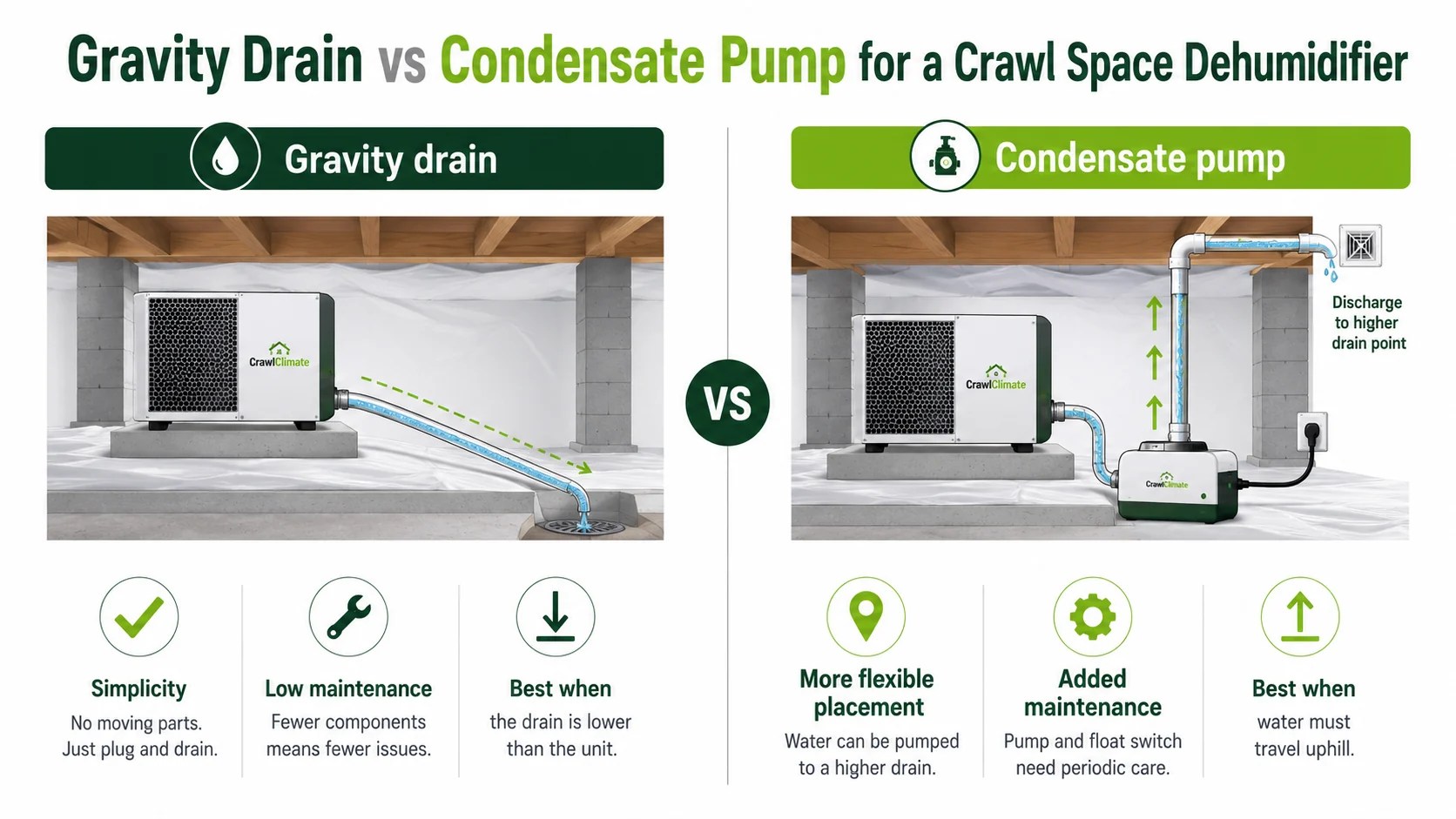
If water can flow continuously downhill from the dehumidifier to a suitable drain, gravity drainage is usually simplest. If the water has to travel uphill, you normally need a condensate pump.
| Gravity drain | Condensate pump | |
|---|---|---|
| Moves water uphill | No | Yes |
| Mechanical complexity | Low | Higher |
| Installation flexibility | Moderate | High |
| Maintenance | Usually minimal | Pump should be inspected |
| Best when | A lower drain is available | Drain is higher or awkwardly located |
How a gravity drain works
Condensate leaves the dehumidifier through a drain connection and travels through tubing or pipe to a lower drainage point. There is no pump motor moving the water.
The important part is the word downhill. The hose needs a reliable downward path from the unit to the drain; a long flat run can hold water and interrupt gravity flow.
Why gravity is usually the first choice
When the installation allows it, gravity drainage is simple. It has fewer moving parts and removes the need for a pump reservoir, float and motor.
Gravity is the simplest option when it also allows good equipment placement. If the available drain would force the unit into a poor airflow location, a pump can create a better installation.
When you need a condensate pump
A pump is useful when the drainage point is above the dehumidifier or when maintaining a continuous gravity slope is impractical.
The pump temporarily collects condensate, then automatically moves it through a discharge hose when the water reaches a set level.
Built-in pump vs external pump
Built-in pump
A built-in pump can make the installation cleaner and reduces the number of separate components. It is convenient when you already know that pumping is required.
External pump
An external pump keeps the pump separate from the dehumidifier. A gravity-drain dehumidifier can therefore still work in a no-floor-drain installation if a compatible external condensate pump is added.
Three simple examples
Floor drain nearby
The drain is lower than the dehumidifier and the hose can slope downhill the whole way.
Best starting point: Gravity drain
The drain line has to rise
The hose needs to climb several feet before it can leave the crawl space.
Best starting point: Condensate pump
Best unit location is far from drainage
A pump can preserve the better airflow location even when the nearest gravity drain is inconvenient.
Best starting point: Compare both layouts
Does a pump make the dehumidifier more powerful?
A pump changes how condensate is removed. The dehumidifier’s moisture-removal capacity stays the same.
When comparing two products, evaluate capacity, operating temperature, airflow and fit for your space first. Then decide whether the drainage arrangement works.
Don’t forget overflow protection
A condensate pump adds another mechanical component that can fail or become blocked. Depending on the equipment and installation, a safety switch can stop the dehumidifier if drainage fails. Follow the manufacturer’s installation instructions and applicable local requirements.
Common drainage mistakes
- A gravity hose rises before reaching the drain.
- Flexible tubing sags and traps water.
- The dehumidifier sits out of level.
- The drain hose is kinked or blocked.
- A pump is selected without checking required lift height.
- The pump is installed and then never inspected.
Know where the water will go.
Where will the dehumidifier sit, where will the condensate discharge, and is that destination lower than the drain outlet?
What would CrawlClimate choose?
If both options are equally practical, gravity drainage is the simpler starting point. If gravity drainage forces poor placement or the water must travel uphill, use a pump.
Based on published sources. How we research and choose products.
Compare gravity and pump-equipped models
- AlorAir HD90 vs HDi90Compare gravity drainage with a built-in pump at the same published capacity.